Definition
Chain Accuracy
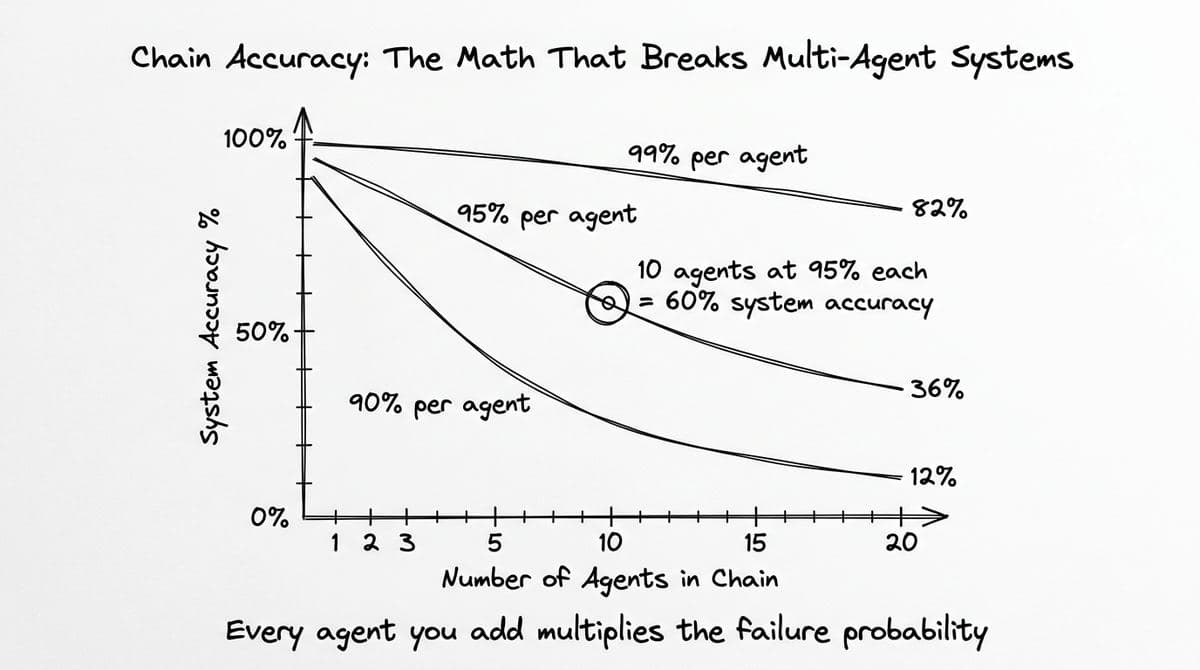
Chain accuracy is the probability that a workflow meets its end-to-end success criterion. When every step must succeed, multiply the first step’s success probability by each later step’s probability of success given that all preceding steps succeeded. Marginal accuracy measured separately for each step does not determine the joint result by itself.
Compare a chain of independent stages with a conditional estimate
Three independent steps at 95% accuracy each give joint accuracy of 0.95³, or about 85.7%. If the second step succeeds 90% of the time after a correct first step and the third succeeds 98% after both, the joint estimate is 0.95 × 0.90 × 0.98, or about 83.8%. Track the observed end-to-end rate alongside stage-level measurements.
Penn State’s multiplication rule for conditional probabilities
Intelligence at Scale by Shashank Agarwal
Explained in
Chapter 11: Multi-Agent Systems
When one agent isn't enough, you build a team.
Related terms