Definition
Positional Encoding
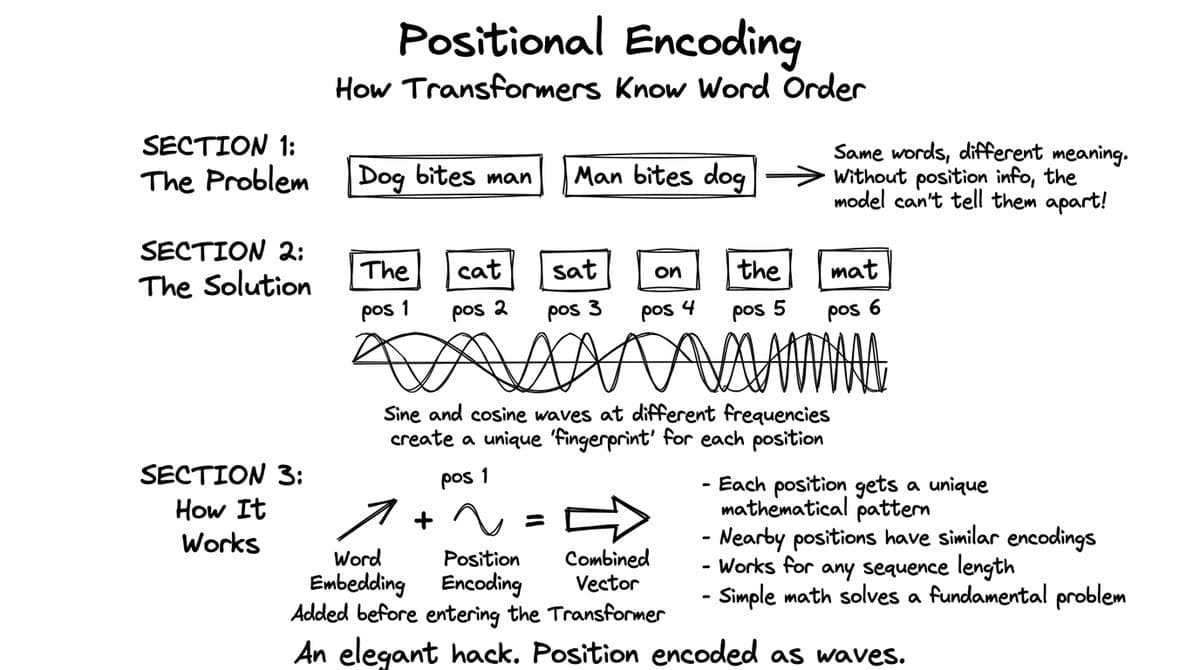
Positional encoding gives a sequence model information about where a token occurs. The original Transformer added fixed sine and cosine vectors to token embeddings. Other architectures use learned position embeddings or methods that incorporate relative position into attention calculations.
Follow the same token across two positions
Put “dog” at position 0 in “dog bites man” and at position 2 in “man bites dog.” Assume both occurrences use the same token ID and start with the same token embedding. In the original Transformer, the vector added at position 0 differs from the one added at position 2. For the first sine coordinate, those contributions are sin(0) = 0 and sin(2) ≈ 0.91. The model receives both a token representation and information about its place in the sentence.
Positional encoding in the Transformer paper
Intelligence at Scale by Shashank Agarwal
Explained in
Chapter 3: Attention Is All You Need FreeThe paper behind every major AI model today. Google invented it. Then watched someone else ship it.
Related terms